

Last week’s StatsEdgePro list produced plenty of winners, a couple duds, and one setup that hasn’t moved yet but looks textbook (see AVTR below). It’s a good moment to talk about a touchy topic: when a systematic trader should intentionally interrupt a rule.
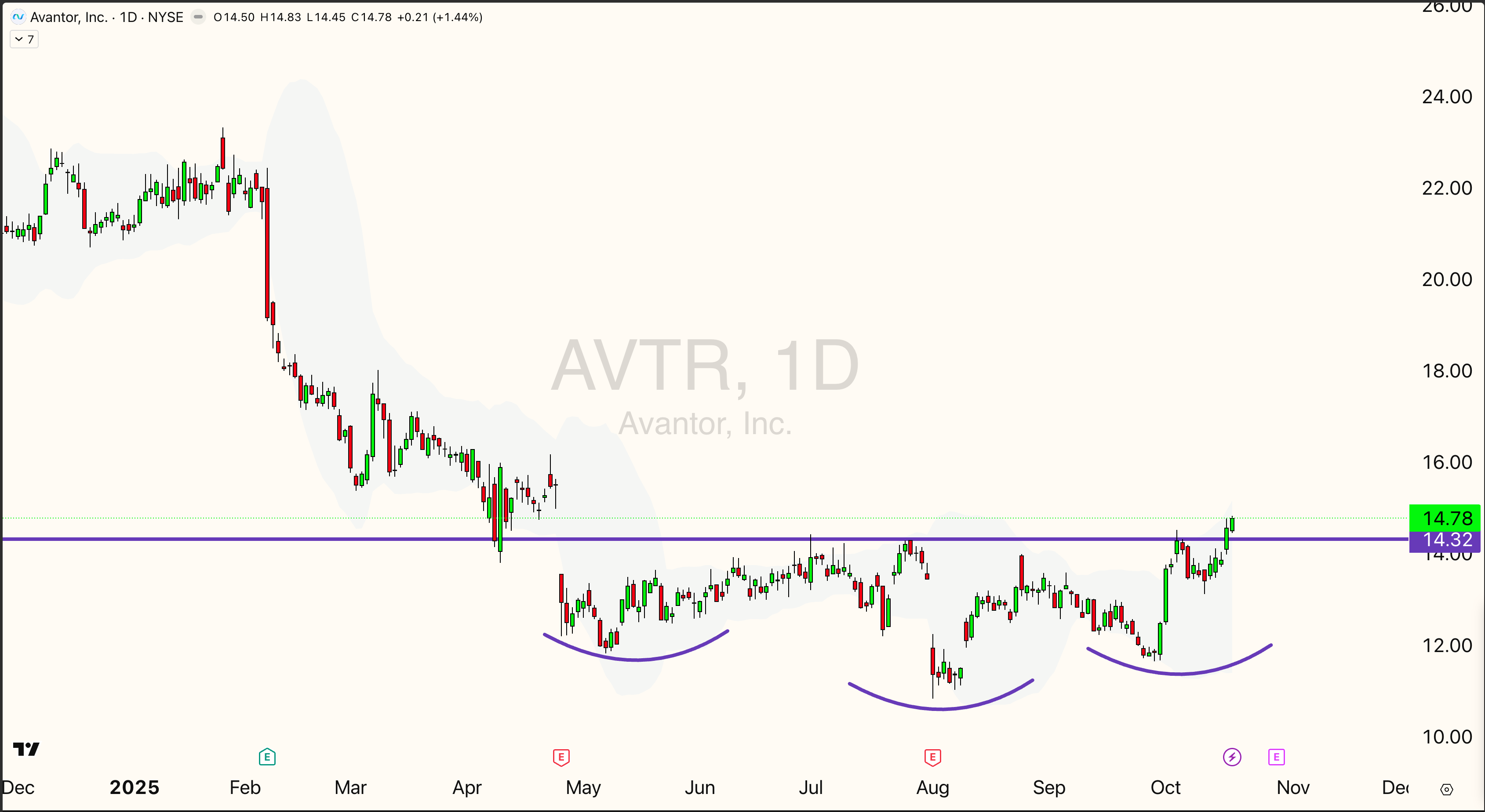
First, the frame: rules run the business. Entries, exits, position sizing—those are decided by code and tested logic. The time to “bend” is not taking trades early or ignoring stops. The only place I allow discretion is after risk is defined and the system has already put me in a profitable position. If an A+ chart is breaking a multi-touch level on real volume, I’ll sometimes keep a piece past the planned exit. I’m choosing to divorce myself from that system outcome to respect what my eyes—and years of stats—are telling me.
The Override Protocol (my checklist)
Use overrides sparingly and consistently:
Edge already realized: At least some money is locked in. Never increase risk.
A+ structure: Fresh breakout from a well-formed base or multi-week level; clean higher-timeframe alignment.
Confirmation: Broad market/sector not fighting the move; relative strength present.
Liquidity & distance: Room to run (ATR multiples to the next obvious level); no binary events in the next week.
Pre-defined plan: What will exit the “runner”? (close back below breakout, prior day’s low, or ATR-trail)
How I implement
Scale, don’t rebel: Follow the system exit on 2/3 of the position. Tag the remaining 1/3 as manual_override.
Tighter rules for the runner: Never widen the stop. Trail under the breakout line or prior day’s low; time-box it (e.g., “give it three daily bars unless momentum persists”).
Journal it: Track overrides as their own cohort so you know if your discretion adds value—or just adds variance.
The downsides (be honest)
Discipline drift: Too many “exceptions” is a new system—usually an untested one.
Data pollution: If you always sell Monday but sometimes don’t, performance attribution gets messy.
Opportunity cost: Capital stuck in a pet idea can block the next high-quality signal.
Why this matters for members
Paid StatsEdgePro members get the full weekly plan—entries, exits, levels, and risk rules—plus my current Override Worksheet and case studies (including this AVTR-style setup). If you’re on the free list and want the exact lists, charts, and the protocol I use when I keep a runner, upgrade and you’ll get the pack every week—so you’re not guessing in the heat of the moment.
Bottom line: be systematic first. When you do override, do it with structure—partial, risk-neutral, and journaled. That’s how you capture the occasional outlier without torching the edge that pays the bills.